Urban revitalization
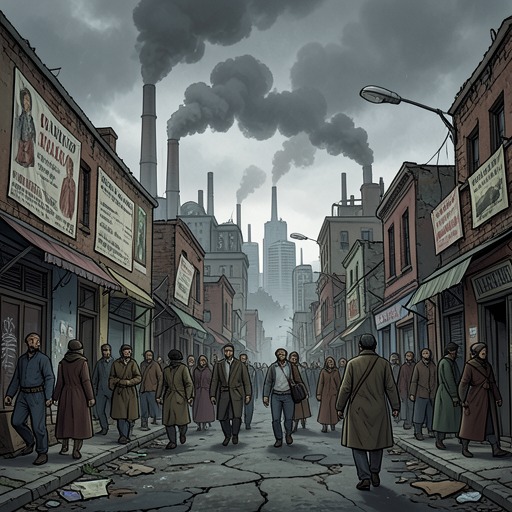
The Short and Tragic Life of Robert PeaceUrban revitalization is the book’s name for the civic project of remaking Newark while the city’s entrenched social conditions continue to reproduce themselves. Its decisive significance lies in the contrast between public declarations of renewal and the ordinary persistence of gang formation, drug sales, violent death, incarceration, poverty, and dreams of leaving. The process appears not as a completed transformation but as a contested, uneven condition: streets may be celebrated as improving while the people who live on them remain bound to immediate obligations and long-term structural limits.
Definition and Civic Promise
Urban revitalization is associated most directly with Cory Booker’s Newark administration. After Rob Peace’s death, Cory Booker continued delivering eloquent speeches about accomplishing what no previous leader had thought possible: revitalizing Newark. Crime statistics formed a central part of those proclamations, making public safety a principal measure by which renewal was explained and defended. The language suggested that the city could be redirected through political will, improved conditions, and a new civic narrative.
Yet the book places that promise within a longer history of uneven opportunity. Rob’s early schooling exposed him to sharp economic differences only a few miles from East Orange: teams from Oakdale Elementary were routinely defeated by more affluent schools in South Orange and Montclair, and Rob and his classmates concluded that money supplied the missing advantage. The same geography later shaped his movement through St. Benedict’s Preparatory School, where boys from forty towns and sixty middle schools entered a disciplined institution committed to forming them into men. Urban revitalization therefore exists beside, rather than above, the unequal distribution of schools, resources, security, and social mobility.
Conditions That Resist Renewal
The neighborhood does not become unrecognizable after Rob’s death. Gangs continue to form and expand; drugs continue to be sold on corners, in homes, and in Orange Park, where Sundays remain set aside for children. People involved with gangs or drugs, or both, continue to be killed. Young mothers nurse infants from stoops, young men—including fathers—go to jail, and children walk home from elementary schools in uniform while listening to rap music and trading candy. These recurring scenes make urban decline less a single crisis than a durable environment of daily routines.
The city’s violence also moves in cycles rather than disappearing under the sign of renewal. Newark records its first murder-free calendar month in more than forty years in March 2010, but the first quarter of 2011 brings a 71 percent increase in violent crime over the same period of the previous year. That reversal undermines any simple narrative in which improved statistics permanently settle the question of safety. Public success and lived insecurity occupy the same civic landscape.
The persistence is social as well as criminal. In the late 1980s, East Orange had roughly sixty thousand residents; a quarter were under eighteen, and 67 percent of those children lived in single-parent homes. More than ten thousand children in Rob’s three-square-mile world shared circumstances shaped by abandonment, death, or imprisonment. Such conditions help explain why one family’s tragedy does not necessarily produce neighborhood-wide shock: in a high-crime area, murder can be absorbed into the background of ordinary life. Revitalization confronts not only visible disorder but the slow accumulation of disrupted attachments, limited resources, and narrowed expectations.
Institutions, Mobility, and Constraint
St. Benedict’s Preparatory School offers the clearest institutional counterimage to the neighborhood’s constraints. During Summer Phase in 1994, 140 fourteen-year-old boys entered through security doors and gathered in the gym known as the Hive. They came from varied economic backgrounds, were weighted toward lower and lower middle class, and understood that the next four years were crucial and offered no easy second chances. The school’s motto, “WHATEVER HURTS MY BROTHER HURTS ME,” defines education as collective obligation rather than individual escape alone.
Rob’s admission to higher education intensifies that tension. Charles Cawley gives him a blank personal check to cover all college expenses, an unprecedented offer among his twenty-five years as a school benefactor. Rob initially considers refusing the charity, but Friar Edwin Leahy tells him that accepting the offer is his responsibility and that he must earn it. The episode shows how mobility can depend on exceptional personal sponsorship rather than on a revitalized public structure. Rob’s education becomes real and transformative, but its availability remains contingent, intimate, and rare.
The same contradiction follows Rob into Yale. He distrusts what he sees as social performance, calling out “fronting” when people act tough, pretend to be poor, or manufacture concern for service workers. He tells Zina that it feels as though nobody at Yale is real and that genuine conversation is difficult. Isabella Peretzian, by contrast, sees him as fundamentally real even after he takes an airline job, interpreting his refusal to become someone else as authenticity. These conflicting readings reveal a city-to-university divide that revitalization cannot erase: Rob carries Newark into elite institutions while learning to conceal, regulate, and compartmentalize the identities that make movement possible.
Revitalization and the Unfinished Aftermath
The book’s final account refuses to measure renewal by official rhetoric alone. Planes continue to fly in and out of Newark International Airport; cars move along Interstate 280 beneath Mt. Carmel; students enter St. Benedict’s for morning convocation; and a disproportionately high share of its boys go on to college. These are genuine channels of opportunity, but they coexist with residents who spend their days managing family and money and their nights imagining that they might someday live elsewhere. For many, those hopes remain “incorporeal constructs” formed by imaginative and hopeful minds.
Rob’s own trajectory embodies the incompleteness of the process. He moves through St. Benedict’s, Yale, scientific research, teaching, aviation work, and entrepreneurial plans, yet educational achievement never permanently severs his ties to the city’s informal economy and its obligations. After his firing from the airline, he returns to drug dealing; later, as violence rises again, he asks for three days to repair a failing operation, insisting that Kamar will not act against him within that time. His request reveals how quickly a promise of reinvention can be pulled back into old networks of trust, risk, and retaliation.
One year and two months after Rob’s death, Curtis Gamble goes to jail. That consequence belongs to the same social world that produces both Rob’s extraordinary educational ascent and his vulnerability. Meanwhile, the city’s seasonal and institutional rhythms continue: children grow, mothers form stoop-side communities, boys attend school, and families adapt to loss. Urban revitalization changes the horizon of what Newark publicly claims to be possible, but it does not by itself alter the forces that determine who can reach that horizon.
Narrative Significance
Urban revitalization functions as a structural counterpoint to Rob Peace’s story. The city is neither treated as irredeemably ruined nor confirmed as successfully renewed. Its streets contain schools, aspirations, political speeches, and routes toward college, but also violence, drug markets, prison, and the repeated disappearance of people into grief or confinement. The result is a portrait of renewal as an uneven process whose visible symbols can coexist with invisible or slow-moving harm.
The ending makes that tension spatially concrete. Jackie crosses from South Orange into East Orange with her car doors locked and windows raised, while at Rosedale Cemetery the grass over Rob’s grave thickens in summer, yellows in fall, and disappears under winter snow. Flowers, a mix CD, or a short note sometimes mark the plot; most of the time it remains indistinguishable from the surrounding grass. The city continues, but continuity is not the same as repair. Urban revitalization survives as a public aspiration, while the private and neighborhood evidence shows how much remains unresolved.